

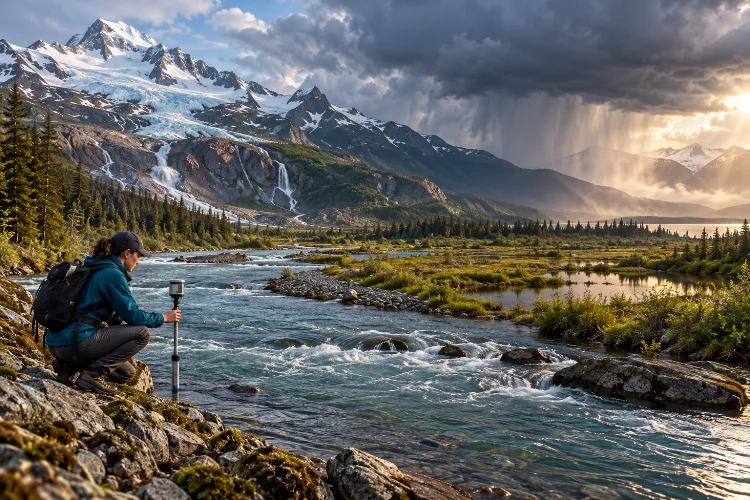
Water never really stays still. A molecule sitting in tropical seawater today might evaporate into the atmosphere, fall as rain over a continent, enter the soil, move through groundwater, and eventually return to the ocean.
That familiar water cycle becomes much more complicated when climate, vegetation, land use, glaciers, and human water demand begin changing at the same time.
Understanding advanced hydrological cycles across changing global environments therefore requires looking beyond the textbook sequence of evaporation, condensation, precipitation, and runoff.
Scientists now track interactions among atmospheric moisture, soil water, rivers, aquifers, snowpacks, glaciers, ecosystems, and oceans.
These connections matter because a warmer climate can intensify some parts of the cycle while weakening or redirecting others.
The IPCC concludes that human-caused climate change has already produced detectable changes in the global water cycle, with important regional differences.
The result is not simply a wetter planet or a drier one. It is an increasingly uneven hydrological system.
The Water Cycle Is Really a Network of Reservoirs
The basic hydrological cycle is powered largely by solar energy.
Water evaporates from oceans, lakes, rivers, soils, and vegetation. Atmospheric moisture later condenses and returns as rain or snow before moving through surface runoff, infiltration, groundwater, rivers, glaciers, and eventually back toward the ocean.
USGS describes the hydrologic cycle as the continuous circulation of water between land, sea, and atmosphere, with groundwater and plant transpiration forming important parts of the system.
What makes the advanced picture interesting is that each reservoir has a different residence time.
Atmospheric water may remain airborne for a relatively short period, while groundwater can stay underground for years, centuries, or much longer. Ice sheets can store water for thousands of years.
Those differences mean environmental change does not affect every part of the cycle at the same speed.
A heavy rainfall event might alter river discharge within hours, while changes in a deep aquifer could take decades to become obvious.
Warming Accelerates Evaporation and Atmospheric Moisture
A warmer atmosphere changes the movement of water even before rainfall begins.
Higher temperatures generally increase evaporation where sufficient water is available. Warmer air can also contain more water vapor, allowing additional moisture to circulate through the atmosphere.
NASA notes that warming of the lower atmosphere can increase evaporation and the amount of moisture moving through the troposphere.
This creates the potential for a more intense water cycle.
More evaporation can dry soils and surface waters, yet additional atmospheric moisture can also contribute to heavier precipitation when conditions allow clouds and storms to develop.
That apparent contradiction is important.
Climate change can increase drought risk in one season or region while contributing to intense rainfall somewhere else. Even the same place may move between unusually dry and unusually wet conditions.
The hydrological cycle therefore becomes less about average rainfall alone and more about timing, intensity, and geographic distribution.
Heavy Rainfall Can Increase Even Where Water Becomes Scarcer
More intense rain does not automatically mean better water availability.
A region might receive a large fraction of its annual preciptation during a few severe storms rather than through regular moderate rainfall.
That changes how water moves through the landscape.
Intense rainfall can overwhelm soil infiltration, sending more water directly into streams and drainage systems. This increases flood risk while potentially reducing the proportion available to recharge groundwater.
Long dry intervals between storms can make the problem worse.
The IPCC finds that the severity of both very wet and very dry events increases in a warming climate, although regional circulation changes strongly affect where those extremes occur.
Recent global observations illustrate the variability. WMO reported that only about one-third of global river basins experienced normal conditions in 2024, with many others showing above- or below-normal flows.
So a changing water cycle is not simply adding water everywhere. It is redistributing water in increasingly irregular ways.
Soil Moisture Connects Rainfall, Vegetation and Drought
Soil acts as a crucial middle layer between atmospheric rainfall and the wider hydrological system.
After rain falls, some water infiltrates into the ground. Plants draw part of this moisture through their roots and release it back into the atmosphere through transpiration.
Together, evaporation and transpiration are called evapotranspiration.
When temperatures rise, atmospheric demand for moisture can increase. Soils can then lose water more rapidly, particularly during periods with little rainfall.
Dry soils reduce the water available to vegetation. Plants may close their stomata to conserve moisture, reducing transpiration and potentially changing exchanges of heat, water, and carbon with the atmosphere.
This helps explain why drought can reinforce heat.
Less soil moisture means less evaporative cooling, allowing more incoming energy to heat the land surface directly.
The IPCC identifies increased atmospheric evaporative demand as an important factor that intensifies plant water stress and contributes to agricultural and ecological drought.
Groundwater Is the Slow but Critical Part of the Cycle
Surface water attracts attention because rivers, lakes, and floods are easy to see.
Groundwater is less visible but equally important.
Water infiltrating sufficiently deep into soils and permeable rock can recharge aquifers. Groundwater then moves slowly underground and may eventually discharge into springs, wetlands, streams, or coastal waters.
During dry periods, groundwater can sustain river flow even when rainfall has stopped.
That makes aquifers valuable buffers against short-term climate variablity.
Problems appear when groundwater extraction consistently exceeds recharge. Agricultural irrigation, urban growth, and industrial use can lower water tables faster than natural processes replenish them.
Climate change can complicate recharge further.
A region receiving similar annual rainfall may experience less aquifer recharge if precipitation becomes more intense and produces greater surface runoff. Changing snowmelt timing and prolonged drought can also alter infiltration.
Modern global water assessments therefore track groundwater alongside streamflow, reservoirs, soil moisture, evapotranspiration, and snow and ice rather than treating it as a separate system.
Snow and Glaciers Act Like Natural Water Storage
In mountain regions, precipitation does not always immediately enter rivers.
Snowpacks and glaciers can store water during cold periods and release it later through melting.
This natural timing system supports rivers during warmer months when rainfall may be limited. Communities, ecosystems, agriculture, and hydropower can depend heavily on this delayed release.
Climate warming changes the system in two important ways.
First, more winter precipitation may fall as rain instead of snow. Second, snow can melt earlier in the year, shifting the seasonal timing of river flow.
Glacier retreat creates an additional long-term problem.
Initially, enhanced melting may temporarily increase downstream flow. But as glaciers lose mass, less stored ice remains available to support future meltwater.
WMO reported widespread glacier losses across all monitored glacier regions for a third consecutive year in 2024, illustrating how rapidly the frozen component of the global water cycle is changing.
Changes in mountain ice can therefore affect water availability far beyond the glacier itself.
Land Use Can Reshape Hydrology Without Changing Rainfall
Climate is not the only force changing water cycles.
Human alteration of landscapes can substantially change what happens after rainfall reaches the surface.
Forests intercept rain and return water to the atmosphere through evapotranspiration. Their roots can improve infiltration and influence soil structure.
Replace a forest with pavement, roads, and buildings and the hydrological response changes dramatically.
Impervious surfaces prevent much of the water from entering the soil. Rain moves rapidly into drains and streams, increasing peak runoff and sometimes urban flood risk.
Agriculture can also transform water movement through irrigation, drainage, soil compaction, reservoir construction, and groundwater pumping.
Wetlands create another important connection. They can temporarily store water, slow runoff, support groundwater interactions, and provide habitat.
Changing land cover therefore alters the same hydrological pathways affected by climate.
This is why modern water science increasingly studies climate and land management together rather than treating them as independent forces.
Drought Develops Through Several Connected Stages
Drought is often described simply as “not enough rain,” but advanced hydrology separates several types.
Meteorological drought begins with persistent precipitation deficits. If those deficits continue, soils dry and agricultural drought can develop.
Eventually, reduced groundwater, reservoir levels, and streamflow may produce hydrological drought.
The IPCC describes this progression from precipitation shortages toward soil-moisture, streamflow, and water-storage deficits. It also notes that higher evaporative demand can intensify ecological and agricultural impacts.
These stages do not always develop at the same speed.
Soils can dry rapidly during a heatwave, while large aquifers may respond much more slowly. Reservoirs can temporarily hide declining rainfall by releasing stored water.
This delayed response is one reason water crises can appear suddenly even though the underlying imbalance has been developing for months or years.
Understanding drought therefore requires monitoring the entire hydrological chain.
Modern Hydrology Depends on Satellites and Global Monitoring
No single measuring station can describe a planetary water cycle.
Scientists now combine river gauges, weather stations, groundwater wells, ocean observations, satellites, snow measurements, glacier monitoring, and numerical models.
Satellites are especially useful for regions where ground observations are sparse.
Different missions can estimate precipitation, soil moisture, changes in terrestrial water storage, snow cover, surface water, and other variables.
WMO’s global water assessments combine national observations with hydrological models and satellite information to examine river discharge, groundwater, evapotranspiration, land-water storage, snow, and ice.
That integrated approach is increasingly important because recent observations show large departures from historical patterns.
WMO’s 2025 assessment continues to describe significant water-related extremes across regions, emphasizing the importance of monitoring the entire water-cycle loop rather than relying on rainfall measurements alone.
Better observations cannot prevent drought or floods, but they can improve forecasting, reservoir management, agricultural planning, and early-warning systems.
The hydrological cycle is far more complex than water simply evaporating, raining, and returning to the ocean. Atmospheric moisture, soils, rivers, groundwatre, vegetation, snow, glaciers, and human infrastructure all interact across different timescales.
Global warming is changing many of these connections by increasing evaporative demand, altering precipitation intensity, shifting snowmelt, and contributing to more extreme wet and dry conditions.
Land-use change and water extraction add another layer of pressure.
To understand future water availability, follow the entire journey rather than focusing only on annual rainfall.
Look at when water arrives, how quickly it runs off, how much reaches soil and aquifers, and where it is stored. That interconected perspective is essential for adapting water management to a changing global environment.
