

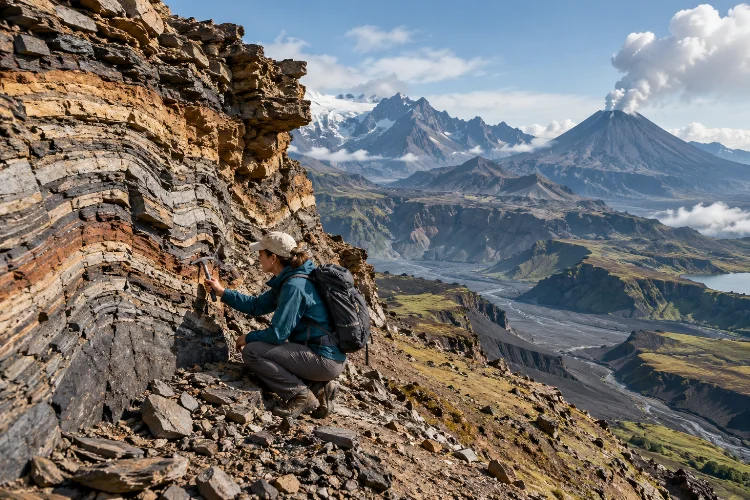
Earth’s surface looks solid and permanent, but on geological timescales it is anything but stationary. Continents collide, oceans open and close, mountain ranges rise, volcanic arcs develop, and pieces of oceanic crust disappear back into the mantle.
These changes unfold slowly – usually over millions of years – but their effects reach far beyond geology.
Understanding how plate tectonics influences long-term Earth system evolution means following connections between Earth’s interior, atmosphere, oceans, climate, and biosphere.
Moving plates recycle carbon, expose fresh rocks to weathering, reshape ocean basins, redistribute nutrients, and continually reorganize habitats.
Tectonic activity therefore acts almost like a long-term planetary architect. It changes the physical geography on which climate and life operate while simultaneously moving chemical elements between Earth’s deep interior and surface environment.
The modern planet is not simply sitting on tectonic plates. Its climate history, ocean circulation, landscapes, and biological evolution have all developed alongside billions of years of tectonic change.
Plate Tectonics Constantly Rebuilds Earth’s Surface
Earth’s lithosphere is divided into moving plates that interact at boundaries where they separate, collide, or slide past one another.
New oceanic crust forms mainly along mid-ocean ridges. Elsewhere, old oceanic lithosphere can descend back into the mantle at subduction zones. According to the USGS, subducting plates can descend at rates of roughly 2–8 centimeters per year.
Those rates seem tiny, but geological time changes the scale completely.
Over tens of millions of years, a few centimeters annually can open an entire ocean basin or move a continent across thousands of kilometers.
Plate reconstruction research therefore provides essential boundary conditions for studying palaeoclimate, palaeobiology, geodynamics, and other aspects of Earth evoluton.
Continents are repeatedly fragmented and reunited. Pangaea is only the most familiar example; evidence also supports earlier major supercontinents such as Rodinia and Columbia.
This repeating assembly and breakup forms the supercontinent cycle, one of the clearest examples of how mantle dynamics and surface geography evolve together.
Tectonics Operates a Long-Term Carbon Conveyor Belt
One of the most important connections between plate tectonics and climate involves carbon.
Carbon stored in marine sediments and oceanic crust can be carried downward when a plate enters a subduction zone. Some becomes stored deeper within Earth, while some eventually returns toward the surface through volcanic and magmatic processes.
This creates what researchers have described as a tectonic carbon conveyor belt.
A 2022 Nature review reconstructed changes in this deep carbon system over the past 250 million years and found that variations in plate speed, subduction, seafloor spreading, and volcanic outgassing were closely connected to major long-term climate states.
For example, faster tectonic activity during parts of the Mesozoic was associated with stronger solid-Earth carbon outgassing and greenhouse conditions.
The slow carbon cycle works on vastly longer timescales than everyday biological carbon exchange. NASA estimates that movement between rocks, oceans, soils, and atmosphere through the slow cycle can require roughly 100–200 million years.
Plate tectonics therefore helps determine how quickly carbon locked in rocks eventually returns to Earth’s surface system.
Mountain Building Changes Weathering and Climate
When continents collide or oceanic plates subduct beneath continents, crust can thicken and mountain ranges can rise.
Mountain building, or orogeny, changes more than scenery.
Fresh rock becomes exposed to rain, flowing water, glaciers, biological activity, and atmospheric gases.
Chemical weathering of silicate minerals can ultimately consume atmospheric carbon dioxide, transferring carbon toward dissolved products and marine sediments.
This process has often been described as part of Earth’s long-term climate thermostat.
NASA, for example, notes that uplift associated with the Himalaya exposed large quantities of rock to chemical weathering, potentially influencing the long-term carbon cycle and cooling trends.
However, modern research shows that the story is more complicated than “more mountains equal less CO2.”
Mountain erosion can also expose sedimentary rocks containing organic carbon and sulfide minerals. Their oxidation can release CO2, while burial of eroded organic carbon can act in the opposite direction.
The climatic effect of mountain building therefore depends heavily on rock type, erosion rates, weatherng processes, and what happens to the material after it leaves the mountains.
Continental Position Reorganizes Ocean Circulation
Ocean currents depend partly on temperature, salinity, winds, and Earth’s rotation.
But geography sets the pathways those currents are allowed to follow.
When tectonic motion opens or closes an ocean gateway, circulation can be reorganized on a planetary scale. At geological timescales longer than about a million years, ocean-land geometry becomes one of the major controls on global overturning circulation.
The opening of passages around Antarctica provides a powerful example.
As tectonic breakup created deeper connections between major ocean basins, water gained increasingly open pathways around the continent.
These changes contributed to the development of Southern Ocean circulation patterns that redistribute heat, carbon, and nutrients around the globe.
Similar effects can occur when tropical gateways narrow or close.
Tectonic changes to the Indonesian Gateway during the Pliocene, for instance, altered the source waters entering the Indian Ocean and affected regional and global climate circulation.
Plate tectonics therefore influences climate not only through atmospheric CO2 but also by literally redesigning the ocean basins through which heat moves.
Supercontinents Reshape Climate and Habitats
Bring most continental land together and the entire Earth system changes.
A supercontinent contains vast interior regions located far from moisture supplied by oceans. Coastal geometry becomes simpler, ocean basins change shape, and mountain belts created during continental collision alter atmospheric circulation.
Break that supercontinent apart and a different planet emerges.
Rifting creates new coastlines and shallow marine environments. New ocean basins expand, currents reorganize, and isolated populations can begin evolving independently.
Over the past roughly two billion years, the assembly and breakup of major supercontinents has been tied to deep mantle convection as well as surface tectonic processes.
These geographical reorganizations provide changing environmental templates for biological evolution.
A species does not evolve on a static map. Continents drift, islands form, mountain barriers appear, and oceans divide populations.
Plate tectonics can therefore influence biodiversity indirectly by altering isolation, dispersal routes, climate zones, and available habitat over millions of years.
Tectonic Weathering Also Controls Nutrient Supply
Carbon receives most of the attention, but tectonics also affects elements required for life.
Phosphorus is a particularly important example.
It is essential for DNA, cellular energy transfer, and biological productivity. Yet much of Earth’s phosphorus begins locked inside rocks.
Weathering releases phosphorus-bearing compounds that rivers can transport toward ecosystems and the ocean. Tectonic uplift, erosion, climate, vegetation, and rock type all influence this supply.
A 2024 review found that tectonic activity is among the important controls on phosphorus weathering over geological time, linking solid-Earth processes with marine productivity, carbon cycling, and atmospheric conditions.
This creates another interconected system.
Tectonics exposes rock. Weathering releases nutrients. Nutrients support biological productivity. Biological productivity influences carbon burial and oxygen cycling.
Solid-Earth geology can therefore influence biological activity through pathways that initially seem completely unrelated to plate movement.
Plate Tectonics Helps Stabilize a Habitable Planet
Earth’s long-term habitability depends partly on keeping surface conditions within ranges where liquid water can persist.
Plate tectonics contributes to this stability through continuous recycling.
Volcanism releases carbon dioxide from Earth’s interior, while silicate weathering removes CO2 over long periods. Subduction carries altered crust and sediments downward, and volcanic systems eventually return part of that material to the surface.
Because silicate weathering tends to accelerate under warmer, wetter conditions, the geological carbon cycle can behave like a slow climate-regulating feedback.
However, this thermostat works extremely slowly.
NASA estimates that weathering feedbacks in the slow carbon cycle require hundreds of thousands of years to substantially rebalance major disturbances.
That timescale is important. Plate tectonics is highly relevant to Earth’s long-term climatic stability, but geological processes cannot rapidly cancel environmental changes occurring over decades or centuries.
The system is powerful precisely because it operates across immense spans of time.
Tectonic Evolution Is Still an Active Research Frontier
Scientists understand the broad framework of plate tectonics extremely well, but many questions about its earliest history remain open.
Researchers still debate exactly when Earth developed a globally connected tectonic regime resembling the modern system.
Evidence from the supercontinent record suggests large-scale cyclic continental organization was operating by at least around two billion years ago, while older Earth may have experienced different tectonic styles.
Researchers are also improving reconstructions of past plate locations.
Combining palaeomagnetism, marine magnetic anomalies, geological structures, geochemistry, mantle imaging, fossils, and computer simulations allows scientists to rebuild increasingly detailed maps of vanished oceans and continents.
Those maps are useful far beyond geology.
They provide the geography needed for climate models, ocean simulations, biological evolution studies, mineral exploration, and reconstructions of the ancient carbon cycle.
Plate tectonics has therefore become a framework connecting many different branches of Earth science.
Plate tectonics influences long-term Earth evolution by continuously changing both the planet’s geography and its chemistry.
Subduction and volcanism recycle deep carbon, mountain building changes weathering, continental drift reorganizes ocean circulation, and tectonic erosion releases nutrients that influence biological productivity.
Supercontinent cycles add another dimension by repeatedly rebuilding the geography in which climate and ecosystems develop.
To understand Earth’s history, it is therefore useful to look beyond earthquakes and volcanoes. Follow what happens after plates move: watch carbon enter the mantle, mountains alter weathering, gateways redirect ocean currents, and new landscapes reshape habitats.
That broader perspective reveals plate tectonics as more than a geological mechanism – it is one of the fundamental systems linking Earth’s interior with its long-term climate, oceans, and biosphere.
