

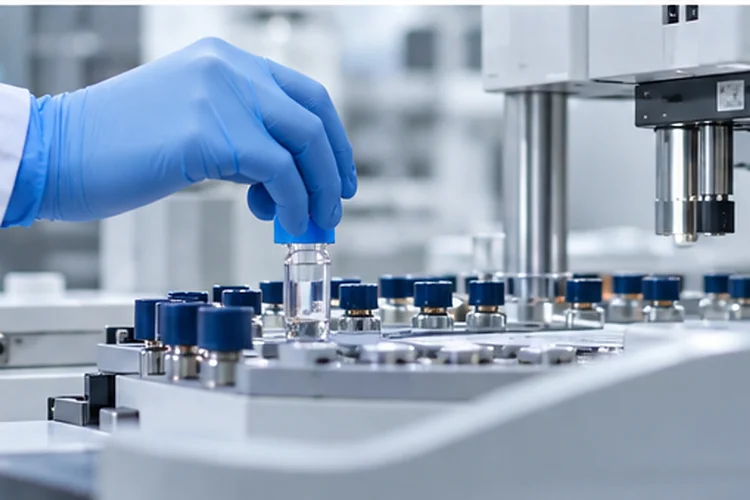
Modern laboratory experiments can become complicated very quickly.
A simple assay may involve several reagents, multiple instruments, different technicians, dozens of samples, several processing days, and software pipelines that transform raw measurements into final results.
Every additional step creates another opportunity for unwanted variation.
This is why advanced experimental controls for complex laboratory research go far beyond simply comparing a treatment group with an untreated group.
Sophisticated experiments often require positive controls, negative controls, procedural controls, reference samples, calibration standards, randomized processing, and methods for detecting batch effects.
These safeguards help researchers answer an essential question: did the experiment measure the biological or chemical phenomenon being investigated, or did something inside the workflow create the result?
Strong experimental controls cannot guarantee that every conclusion will be correct. They can, however, expose technical problems earlier, reduce bias, and make unexpected findings easier to interpret.
In complex research, that difference can determine whether an interesting signal becomes dependable scientific evidence.
Start With the Right Positive and Negative Controls
Positive and negative controls remain the foundation of laboratory research, but their roles become more important as experiments become complicated.
A negative control represents a condition where researchers expect no experimental effect. If that control produces a strong signal, something may be wrong.
Contamination, nonspecific binding, background fluorescence, or software processing could be responsible.
A positive control does the opposite. It contains a condition known or expected to produce a measurable response.
Imagine testing a new compound intended to activate a cellular signaling pathway. An untreated sample may serve as the negative control, while a well-established activator can function as the positive control.
If the new compound produces no response but the positive control works, the compound itself may simply be ineffective. If neither produces a response, however, the assay may have failed.
This distinction prevents researchers from interpreting technical failure as meaningful biology.
NIH guidance describes scientific rigor as the use of well-controlled experimental design, methodology, analysis, interpretation, and reporting to support robust and unbiased findings.
Add Procedural Controls to Test the Workflow
Some failures occur not because of the experimental treatment, but because of the procedure used to deliver it.
That is where procedural controls become useful.
Suppose researchers are studying the effect of injecting a drug into laboratory animals. The treatment involves more than the drug itself. Animals are handled, restrained, injected, and exposed to a vehicle solution.
A proper comparison might therefore include a vehicle control that receives everything except the active compound.
The same logic applies to molecular biology. Researchers performing a DNA amplification experiment may include a no-template control to determine whether reagents have become contaminated.
Complex workflows may require controls at multiple stages rather than one control at the end. If samples move through extraction, amplification, labeling, sequencing, and computational analysis, controls placed at different points can help identify exactly where an error appeared.
This is especially valuable because troubleshooting an entire experimental pipeline after completion can be extremely dificult.
Use Reference Samples to Track Batch Effects
Many modern laboratory studies cannot process every sample simultaneously.
Perhaps an instrument can analyze only 20 samples per run, while the experiment contains 200 samples. Researchers now have ten separate batches.
That creates a new problem.
Small differences in reagent lots, room temperature, instrument calibration, operator technique, or processing time can make measurements from Monday systematically different from measurements collected Friday.
These differences are known as batch effects.
In high-dimensional experiments, they can be particularly dangerous because technical variation may resemble meaningful biological differences.
Nature Methods guidance for single-cell proteomics recommends randomizing treatments across analytical batches whenever possible.
It also recommends including consistent reference material across batches so technical variation can be estimated rather than confused with the biological effect being studied.
For example, instead of processing every control sample in batch one and every treated sample in batch two, researchers can distribute both conditions across multiple runs.
This turns batch from a hidden confounder into something researchers can observe and model.
Randomize More Than Treatment Assignment
Randomization is often discussed as a way of deciding which experimental unit receives a treatment.
In sophisticated laboratory research, researchers should think more broadly.
Sample position on a plate can matter. Processing order can matter. Cage location, freezer position, sequencing lane, instrument run, and even the time of day can sometimes influence measurements.
Imagine using a 96-well plate and placing every control sample on the left side while every treatment sample goes on the right.
If temperature, evaporation, or detection sensitivity differs slightly across the plate, position becomes inseparable from treatment.
Randomizing or systematically balancing sample positions can prevent this problem.
NC3Rs guidance recommends considering nuisance variables including sample position, timing, housing location, age, and other factors that might introduce systematic differences.
It also notes that randomization can be applied throughout the experimental process, including the order in which measurements are performed.
Advanced control therefore means asking not only what treatment did this sample receive? but also where, when, and in what order was it processed?
Control Measurement Error With Calibration and Standardization
Laboratory instruments do not produce perfect measurements forever.
Sensors drift. Pipettes lose calibration. Optical systems become misaligned. Reagents degrade. Software settings change.
Without measurement controls, researchers may mistake instrument drift for an experimental effect.
Regular calibration helps establish whether equipment is operating within an acceptable range. Researchers can also use reference standards with known properties to check whether measurements remain comparable between sessions.
Standard operating procedures provide another layer of protection.
Timing, temperature, reagent concentration, incubation periods, equipment settings, and sample preparation methods should be described precisely enough that different technicians can perform the procedure consistently.
NC3Rs recommends careful technique, suitable equipment, randomization, and blinding as ways of minimizing measurement error. It also highlights factors such as measurement timing and measurement order because these details can influence the final result.
The goal is not to eliminate every source of variation. That is rarely possible.
Instead, researchers want technical variation to remain small enough that genuine experimental differences can still be seen.
Blind Researchers When Measurements Require Judgment
Automation has improved laboratory science, but many experiments still contain subjective decisions.
Someone may decide which cells count as abnormal, select regions from microscope images, score animal behavior, remove questionable measurements, or decide whether an assay result passes quality control.
If that person knows which samples received the treatment, expectations may unconsciously influence those decisions.
Blinding provides a straightforward defense.
Samples can be assigned neutral identification codes so that researchers performing measurements do not know which condition they are evaluating.
NC3Rs notes that studies without blinding can report larger treatment effects and recommends keeping researchers unaware of treatment allocation during measurement and, where practical, during data analysis.
Blinding does not need to be perfect to be useful.
When researchers cannot remain blinded during treatment administration, another investigator might perform outcome measurements without knowing the group identities. Data files can also be coded before they reach the analyst.
This reduces the opportunity for expectation to quietly influence the measurment process.
Build Internal Quality Controls Into Every Experimental Stage
Waiting until the end of an experiment to discover something went wrong is expensive.
A better strategy is to build quality checkpoints throughout the workflow.
Imagine an experiment involving RNA extraction, sequencing, and computational analysis.
Researchers might verify RNA quality immediately after extraction rather than waiting until sequencing fails. They might check library quality before loading samples onto an expensive instrument.
This approach creates a chain of evidence showing that each stage worked before the next one began.
Quality controls should also have predefined acceptance criteria.
Researchers should decide beforehand what counts as acceptable instrument performance, contamination levels, signal intensity, or sample quality. Otherwise, there is a risk of changing quality rules after seeing whether particular samples support the expected conclusion.
Good laboratory control systems therefore operate almost like diagnostic tools for the experiment itself.
When something unusual happens, the controls should help researchers identify whether the source was biological, procedural, analytical, or instrumental.
Balance Tight Control With Real-World Relevance
There is one important limitation to laboratory control: an experiment can become too controlled.
Suppose a biological effect appears only at one exact temperature, using one reagent lot, one cell line, and one instrument. The experiment may be highly repeatable within a particular laboratory while remaining fragile outside it.
Advanced researchers therefore distinguish between unwanted technical noise and meaningful biological variation.
Sometimes introducing controlled heterogeneity can actually strengthen a study.
Researchers might repeat an experiment using different experimental batches, strains, laboratories, operators, or environmental conditions. If the effect survives those changes, it is more likely to generalize.
NC3Rs notes that systematic variation across strains, conditions, or sites can produce results that are more generalisable than experiments conducted under extremely narrow conditions.
The purpose of controls is therefore not to make every experiment artificially identical.
It is to understand where variation comes from and prevent irrelevant variation from being confused with the phenomenon being studied.
Advanced laboratory research needs more than one untreated control sitting beside a treatment group.
Complex experiments often require positive and negative controls, procedural controls, calibration standards, shared reference samples, randomization, blinding, and quality checkpoints throughout the workflow.
These strategies help scientists detect contamination, batch effects, instrument drift, procedural failure, and unconscious bias before they become convincing-looking conclusions.
The most effective approach is to design controls alongside the experiment rather than adding them as an afterthought.
Before starting your next laboratory study, map every major step from sample preparation to data analysis. Ask what could fail at each stage, what signal that failure would create, and which control would expose it.
That simple exercise can make complex experiments much more interpretable, reproducable, and trustworthy.
