

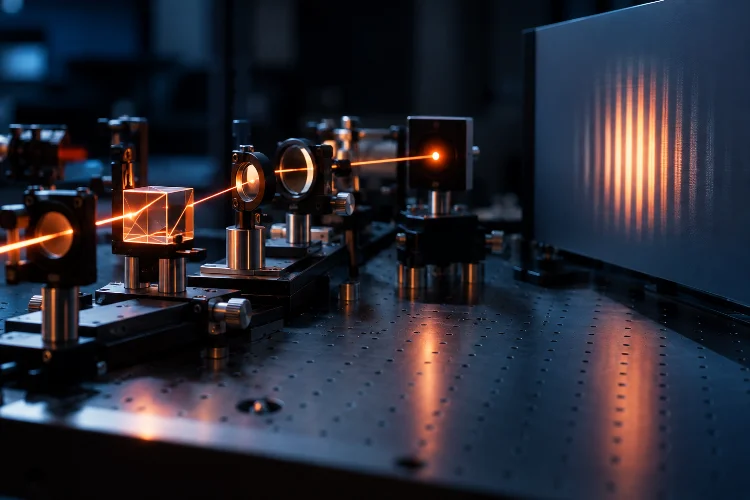
A photon can arrive at a detector as one localized event, yet thousands of photons sent through an interferometer can gradually build a wave-like interference pattern. Electrons, atoms, and even large molecules can produce similarly strange results.
This is the puzzle traditionally called wave-particle duality.
Modern quantum physics has moved far beyond the simple idea that tiny objects occasionally “switch” between being particles and waves.
Quantum objects are described by states that can produce particle-like detection events while also evolving through superposition and interference.
Understanding advanced wave-particle duality across modern quantum experiments therefore means looking at what laboratories actually measure.
Double-slit experiments, molecular interferometers, delayed-choice setups, and atomic-scale electron experiments reveal that the behavior we observe depends strongly on how an experiment is arranged and what information is physically available.
The result is one of the clearest reminders that classical categories are not always adequate for describing the quantum world.
Why the Classical Wave-versus-Particle Picture Breaks Down
Classical physics gives waves and particles very different identities.
Particles are localized objects. A classical ball travels along a particular trajectory and eventually hits a particular location.
Waves behave differently. They spread through space, overlap, diffract around obstacles, and create interference patterns when multiple paths combine.
Quantum objects show features of both descriptions without fitting perfectly into either.
A single electron can strike a detector at one specific point, which looks particle-like. Yet when many identically prepared electrons pass through an interference experiment, the accumulated distribution follows a wave-like interference pattern.
The important lesson is not that an electron secretly transforms from a particle into a classical wave.
Modern quantum mechanics instead assigns it a quantum state whose evolution can include superposition and interference, while measurement produces discrete outcomes.
Wave-particle duality is therefore useful language, but the underlying physics is genuinely quantum rather than a simple mixture of two classical behaviours.
The Double-Slit Experiment Still Captures the Core Mystery
The double-slit experiment remains the most famous demonstration of duality because its logic is so simple.
Classically, particles passing through two openings should create two concentrated regions behind the slits. Waves passing through them can overlap and create alternating regions of constructive and destructive interference.
Quantum experiments produce something more surprising.
Particles can be sent toward the experiment one at a time. Each produces an individual detection event, yet after enough events have accumulated, an interference pattern appears.
Researchers have demonstrated this behavior with electrons, atoms, neutrons, and molecules.
A particularly visual 2012 experiment recorded individual organic molecules arriving at a detector one by one. Over time, those apparently random impacts produced a clear interference pattern, offering a striking real-time demonstration of matter-wave behavior.
The experiment shows why neither a purely classical particle nor a purely classical wave description is sufficient.
Matter Waves Extend Duality Far Beyond Photons
Wave-like behavior is not limited to light.
Louis de Broglie’s matter-wave idea associates a wavelength with moving particles. The de Broglie wavelength becomes shorter as momentum increases, which helps explain why wave behavior becomes difficult to notice for ordinary macroscopic objects.
Electrons provided early evidence for matter waves, but increasingly sophisticated experiments have pushed the principle toward much larger systems.
In 1999, researchers demonstrated interference using C60 fullerene molecules. These molecules were considerably more complex than individual atoms and still produced measurable matter-wave interference.
Two decades later, experiments went much further.
A 2019 Nature Physics study demonstrated quantum interference with molecules exceeding 25,000 daltons and containing up to about 2,000 atoms. Their de Broglie wavelengths were only around 53 femtometres, dramatically smaller than the molecules themselves.
Experiments like these steadily push the boundary between microscopic quantum systems and objects that begin to look more classically complicated.
Which-Path Information Changes the Interference
One of the deepest lessons from interference experiments concerns information.
To obtain a strong interference pattern, the alternative paths through the experiment must remain sufficiently coherent. If the setup makes reliable information available about which path the quantum object followed, interference is reduced or lost.
This relationship is sometimes described through complementarity.
Wave-like interference visibility and particle-like path distinguishability cannot both be maximized in the same experimental arrangement. Modern experiments have tested quantitative relations between these two aspects of quantum behavior.
The point is more subtle than saying “looking at the particle disturbs it.”
A detector does not need a conscious observer. What matters is whether the quantum system becomes physically correlated with something that can distinguish the alternatives.
Path information can become encoded in another quantum system, polarization state, measuring device, or surrounding enviroment.
Once those alternatives become distinguishable, the conditions needed for visible interferance change.
Delayed-Choice Experiments Challenge Classical Stories
Wave-particle experiments become even stranger when researchers delay the choice of measurement arrangement.
John Wheeler proposed a famous thought experiment in which the decision to reveal interference or path information is made only after the quantum object has entered the apparatus.
A classical story might suggest that the particle must have decided earlier whether to behave as a wave or particle.
Quantum mechanics does not require that story.
In 2015, researchers performed an atomic version of Wheeler’s delayed-choice experiment using single ultracold helium atoms in an interferometer.
The setup demonstrated that the observed wave-like or particle-like behavior depended on the measurement configuration rather than on a simple pre-existing classical identity.
Importantly, delayed-choice experiments do not require information to travel backward through time.
They instead highlight the danger of assigning definite classical paths to quantum systems when the experiment does not actually establish those paths.
Larger Objects Reveal the Importance of Decoherence
If molecules containing thousands of atoms can interfere, why does a football never behave like a visible matter wave?
Part of the answer is decoherence.
Large objects interact constantly with their surroundings. Air molecules collide with them, thermal radiation is emitted and absorbed, photons scatter from their surfaces, and countless internal degrees of freedom interact.
Those interactions can carry information about different components of a quantum superposition into the environment.
As coherence disappears, observable interference becomes extraordinarily difficult to maintain.
Large-molecule interferometry is valuable partly because it allows researchers to explore this transition experimentally.
The 2019 molecular-superposition work, for example, was designed not only to demonstrate matter waves but also to place stronger constraints on possible deviations from standard quantum mechanics.
This research asks an important question: is there a fundamental size limit to quantum superposition, or does classical behavior emerge primarily because maintaining coherence becomes overwhelmingly difficult?
So far, experiments continue to agree remarkably well with quantum theory.
Modern Experiments Keep Finding New Forms of Matter-Wave Behavior
Wave-particle research is far from finished.
In late 2025, researchers reported diffraction of positronium, a short-lived bound system consisting of an electron and its antimatter counterpart, a positron. The work provided another direct demonstration of matter-wave diffraction in a distinctive composite quantum system.
More recently, an August 2026 Nature study demonstrated atomic-scale double-slit interferometry using a focused electron probe.
The experiment extended the double-slit idea into an extremely small spatial regime and showed how sophisticated electron microscopy can probe fundamental quantum interference.
Modern experiments therefore do much more than repeat textbook demonstrations.
Scientists now manipulate matter waves across different particle types, masses, energies, and spatial scales. Each experiment tests whether quantum predictions survive under increasingly demanding conditions.
So far, they have.
Duality Is Better Understood Through Quantum Information
The phrase “wave-particle duality” remains useful, but many physicists now frame the issue through quantum information.
The crucial questions become: which alternatives are coherent, what path information exists, which observables are measured, and how strongly has the system interacted with its surroundings?
This perspective avoids forcing quantum systems into classical boxes.
A photon does not need to possess a hidden label reading “wave mode” or “particle mode.” The same quantum state can produce different observable phenomena depending on the measurment context.
Interference reveals coherent relationships between alternative possibilities. Localized detection reveals the discrete nature of individual measurement events.
Both belong to one quantum framework.
This network of superposition, coherence, distinguishability, and measurement provides a much richer picture than simply saying that microscopic objects are somehow both waves and particles.
Why Wave-Particle Duality Still Matters Today
Wave-particle research is not only about philosophical questions.
Interference lies behind atom interferometers, electron microscopy, quantum sensing, precision measurement, and many emerging quantum technologies.
Matter-wave interferometers can detect extremely small physical changes because their interference phase is sensitive to acceleration, rotation, forces, and other environmental effects.
At the same time, increasingly massive superposition experiments test the limits of quantum mechanics itself.
If future experiments discovered a systematic failure of interference at a particular scale that could not be explained by ordinary decoherence, it could point toward new physics.
That is why experiments continue to become larger, more precise, and more carefully controlled.
A century after de Broglie proposed matter waves, wave-particle duality is still an active experimental frontier rather than just a chapter in an introductory physics textbook.
Wave-particle duality shows why quantum objects cannot be understood simply as smaller versions of classical objects. Individual detection events appear localized, yet their statistical patterns can reveal diffraction, superposition, and interference.
Modern experiments have demonstrated these effects with photons, electrons, atoms, antimatter systems, and increasingly massive molecules.
Delayed-choice studies and measurements of path information further show that experimental context plays a fundamental role in determining what behavior can be observed.
The next time you encounter the phrase “wave or particle,” avoid treating it as a literal choice between two classical identities.
Instead, look at the quantum state, available path information, coherence, and measurement setup. That perspective gives a far more accurate picture of what modern experiments are actually telling us about physical reality.
