

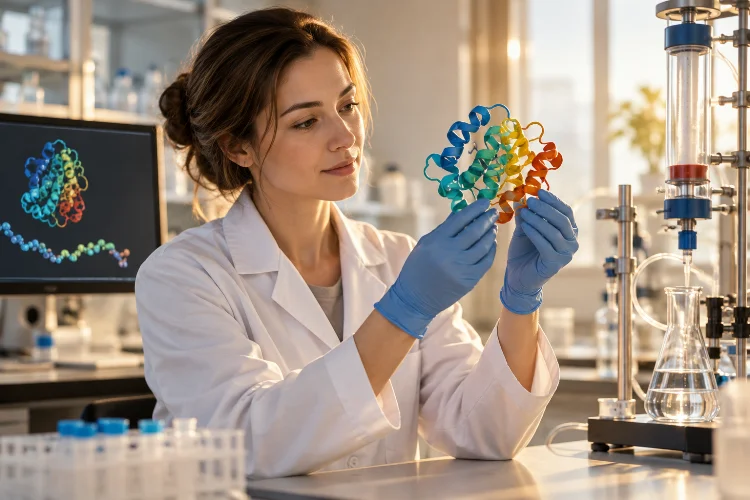
A protein begins life as something surprisingly simple: a chain of amino acids emerging from a ribosome. Yet that chain usually needs to become a highly organized three-dimensional structure before it can perform its biological job.
Getting there is anything but trivial.
Proteins contain hundreds or even thousands of atoms capable of interacting in countless ways. Still, many proteins reach functional shapes rapidly inside crowded cells filled with other molecules.
Others need assistance from specialized molecular chaperones, while damaged or incorrectly folded proteins may need to be repaired or destroyed.
Understanding advanced protein folding concepts and their biological importance therefore connects structural biology with almost every part of cell function. Enzymes, receptors, antibodies, transport proteins, and molecular machines all depend on appropriate folding.
When this process fails, proteins may lose their normal activity or form harmful aggregates. Protein folding is therefore not simply a structural puzzle – it is an essential component of cellular survival, disease biology, and modern biomedical research.
Amino Acid Sequence Shapes the Folding Possibilities
The amino acid sequence of a protein contains much of the information needed to create its three-dimensional structure.
Different amino acids have different chemical properties. Some interact easily with water, while hydrophobic residues often become buried inside folded proteins. Charged and polar groups can form electrostatic interactions and hydrogen bonds.
These combined forces help guide a polypeptide toward particular conformations.
Classic refolding experiments helped establish that certain purified proteins can return to functional structures after being unfolded, demonstrating that important folding information is encoded in amino acid sequence.
However, folding inside living cells is considerably more complicated than folding a small purified protein in a test tube.
The cellular environment is crowded, proteins are continuously being synthesized, and partially folded chains can interact incorrectly with surrounding molecules.
Sequence therefore provides the possibilities, but cellular machinery frequently helps proteins navigate them safely.
Protein Folding Follows an Energy Landscape
It is tempting to imagine a protein testing every possible shape until it discovers the correct one.
That would take an unrealistic amount of time.
Modern folding models instead describe an energy landscape in which many possible conformations gradually move toward lower-energy states.
Rather than following one perfectly fixed path, different molecules can sometimes use multiple routes toward a similar final structure.
The landscape is often represented as a funnel.
At the top are many high-energy, relatively disorganized conformations. As folding progresses, the number of accessible arrangements generally narrows until the protein reaches a stable or functionally useful conformaton.
However, the landscape is not perfectly smooth. Proteins can encounter intermediate states, energetic barriers, or local minima where incorrect structures become temporarily trapped.
Importantly, scientists still do not completely understand how all proteins fold.
A 2026 Nature Reviews Molecular Cell Biology article noted that even though structure prediction has advanced dramatically, fundamental questions remain about whether folding is best described by energy funnels, cooperative folding units, or combinations of these mechanisms.
Folding Often Begins Before Protein Synthesis Ends
Protein folding does not always wait until translation is complete.
As a growing polypeptide emerges from the ribosome, regions of the chain can begin adopting local structures. This process is called co-translational folding.
That timing matters.
The N-terminal region of a protein becomes available before later regions have even been synthesized. As a result, the direction and speed of translation can influence which interactions are possible during early folding.
Cells also position molecular chaperones near ribosomes so they can interact with newly synthesized chains.
Chaperone networks such as Hsp70 can bind exposed hydrophobic regions of emerging proteins and reduce the chance that partially folded chains will form inappropriate contacts with each other.
Research on cytosolic folding shows that chaperone assistance can begin as proteins emerge from ribosomes and continue through later maturation.
Protein production and protein folding are therefore closely connected processes rather than completely separate stages.
Molecular Chaperones Guide Difficult Folding Problems
Some proteins can fold largely by themselves under appropriate conditions. Many others benefit from molecular chaperones.
Despite the name, chaperones usually do not directly specify the final protein structure.
Instead, they help prevent inappropriate molecular interactions and give unstable proteins better opportunities to reach productive conformations.
Hsp70 is one of the best-known chaperone systems. It works with co-chaperones and ATP-driven cycles to bind and release client proteins. Hsp90 assists the maturation and stability of numerous proteins, including important components of cellular signaling pathways.
Chaperonins provide another solution.
These protein complexes can create protected folding environments where a substrate is temporarily isolated from the crowded cytosol.
The overall chaperone network can perform several jobs: assisting folding, stabilizing partially folded proteins, helping proteins cross membranes, supporting assembly, and directing irreversibly damaged proteins toward degradation.
This makes chaperone machinary a central component of protein quality control rather than an emergency system used only when something goes wrong.
Misfolding Can Turn Useful Proteins Into Cellular Problems
The same chemical properties that allow proteins to fold can also create risks.
Partially folded proteins may expose hydrophobic surfaces normally buried inside the final structure. Those regions can interact with similar exposed surfaces on neighboring proteins.
The result may be protein aggregation.
Some aggregates remain relatively disorganized, while others can develop highly structured amyloid architectures. Misfolded proteins may also encourage additional molecules to adopt abnormal conformations, creating self-reinforcing aggregation processes.
Misfolding can harm cells in several ways.
A protein may simply lose its normal biological function. Alternatively, abnormal conformations and aggregates can acquire new toxic properties, disturb membranes, interfere with cellular trafficking, overwhelm quality-control systems, or disrupt other proteins.
Aggregation is strongly associated with neurodegenerative disorders. Different diseases involve different proteins, but misfolding and accumulation are recurring features in conditions including Alzheimer’s and Parkinson’s diseases.
That does not mean every protein aggregate has exactly the same biological effect. The size, structure, location, and molecular composition of aggregates can all influence toxicity.
Proteostasis Keeps the Cellular Protein Population Healthy
Cells need more than folding machinery. They need an entire system for managing proteins from synthesis to destruction.
This broader network is known as proteostasis, or protein homeostasis.
Proteostasis includes ribosomes, molecular chaperones, folding enzymes, stress-response pathways, trafficking systems, the ubiquitin–proteasome system, autophagy, and other mechanisms that monitor protein condition.
Chaperones may rescue proteins that have temporarily lost their structures. Proteins that cannot be repaired can instead be targeted for degradation before they accumulate.
This balance becomes especially important during stress.
Elevated temperature, oxidative damage, mutations, chemical exposure, and other disturbances can increase the frequency of misfolding. Cells respond by increasing protective pathways, including production of heat-shock proteins.
Proteostasis networks are therefore dynamic rather than fixed. They continually allocate resources between folding, repair, sequestration, and destruction.
A decline in this capacity can make organisms increasingly vulnerable to protein damage, particularly as aging progresses.
Protein Structure Is Dynamic, Not Completely Rigid
Textbooks often show proteins as solid three-dimensional objects.
Real proteins are much more flexible.
Atoms continuously move, domains shift positions, and some regions may transition between several conformations. This flexibility can be essential for biological function.
An enzyme might change shape when binding its substrate. A receptor can move between inactive and active conformations. Molecular motors undergo coordinated structural changes that convert chemical energy into movement.
Some proteins also contain intrinsically disordered regions that lack one fixed structure under normal conditions.
Rather than representing failed folding, this flexibility may help them interact with multiple partners or respond rapidly to regulatory signals.
This changes how protein folding should be understood.
The goal is not always one perfectly rigid lowest-energy structure. Biological activity can depend on an ensemble of closely related states, with interactions or modifications shifting the balance between them.
In other words, folding creates functional molecular flexibility as well as structure.
Folding Research Is Changing Medicine and Biotechnology
Protein folding is no longer only a theoretical problem.
Understanding how proteins acquire and lose structure has direct applications in medicine, drug development, biotechnology, and synthetic biology.
Researchers studying aggregation diseases can investigate ways to stabilize vulnerable proteins, prevent toxic interactions, enhance chaperone activity, or improve cellular clearance mechanisms.
Protein engineering also depends heavily on folding principles.
A redesigned enzyme may have excellent theoretical catalytic properties but be useless if it becomes unstable or aggregates when produced.
Scientists therefore consider both function and fold stability when engineering therapeutic proteins, industrial enzymes, antibodies, and other biomolecules.
Machine-learning tools have also transformed protein structure prediction. Yet accurate structure prediction does not mean the folding problem has been completely solved.
Researchers still need to understand the physical pathways proteins follow, how cellular environments influence them, and why similar proteins sometimes show very different folding behaviors.
This continuing research is likely to connect computational predictions increasingly closely with real molecular dynamics.
Protein folding transforms newly synthesized amino acid chains into structures capable of performing biological work.
Sequence provides much of the structural information, but energy landscapes, co-translational folding, molecular chaperones, and cellular quality-control systems determine whether proteins reach and maintain useful conformations.
When folding goes wrong, cells may face lost protein function, harmful aggregation, or disruption of entire proteostasis networks. That is why folding matters far beyond structural biology.
When studying any protein, look beyond its final three-dimensional image. Ask how it reaches that structure, how cells maintain it, what happens when it becomes unstable, and how the protein responds to stress.
Those questions reveal why protein folding is one of the most fundemental processes connecting molecular structure with biological life.
