

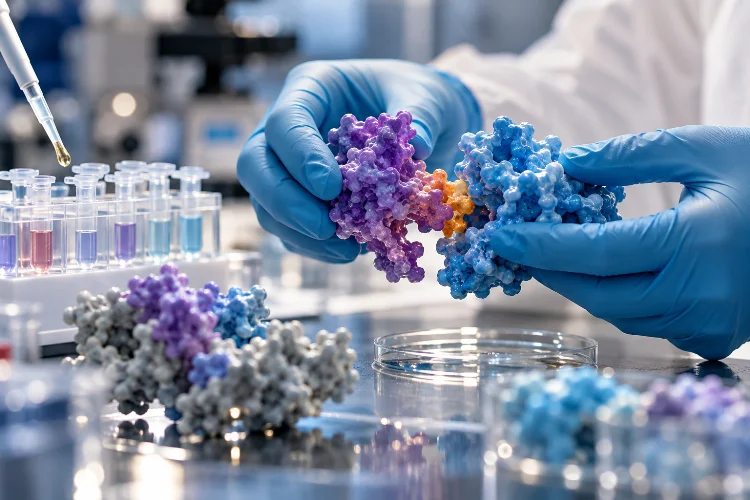
A protein rarely works completely alone. Inside a living cell, proteins constantly meet, bind, separate, compete, assemble into larger complexes, and change each other’s activity.
These interactions can last for milliseconds or remain stable for hours. Some form large molecular machines, while others briefly connect signaling molecules long enough to pass information from a cell-surface receptor toward the nucleus.
Understanding how protein interactions control complex biological processes is therefore essential for understanding modern cell biology.
A protein’s amino acid sequence and three-dimensional shape matter, but its biological role often depends just as heavily on which partners it can recognize and when those interactions occur.
Protein networks help cells divide, repair DNA, move materials, generate energy, respond to hormones, defend against pathogens, and control gene expression.
When those networks break down, the result can contribute to cancer, neurological disease, immune dysfunction, and many other disorders.
The cell is not simply a collection of proteins. It is a constantly changing network of molecular relationships.
Protein Binding Creates the Basic Logic of Cellular Activity
Proteins interact because their molecular surfaces contain regions capable of recognizing particular partners.
These interfaces depend on shape, charge, hydrogen bonding, hydrophobic interactions, and other noncovalent forces. A useful protein interaction requires enough molecular complementarity for two partners to recognize each other selectively.
The interaction does not always need to be permanent.
Some proteins form highly stable complexes, while others associate only briefly.
According to Molecular Biology of the Cell, proteins can form both permanent and transient associations, and those interactions can be altered by phosphorylation, ligand binding, or competition with other proteins.
That flexibility is extremely useful.
A permanent interaction can help build a stable cellular structure, while a short-lived interaction can act like a molecular switch. Cells use both strategies depending on whether they need stability or rapid responsiveness.
Stable and Transient Interactions Serve Different Purposes
Not every protein partnership performs the same kind of job.
Stable protein complexes are especially important when multiple molecular components must work together repeatedly. Ribosomes, for example, depend on coordinated interactions among proteins and RNA molecules to translate genetic information into new proteins.
Other biological systems rely heavily on transient associations.
Signaling proteins may interact for only a short time after a receptor is activated. Once the message has been passed to the next component, the complex can disassemble.
These temporary interactons allow cells to respond quickly without permanently changing their molecular architecture.
The difference between stable and transient binding also gives cells a way to regulate timing. A complex that assembles only when a particular molecule is phosphorylated can effectively remain switched off until the correct signal arrives.
Protein function therefore depends not only on who binds whom, but also on how strongly, how quickly, and for how long the interaction occurs.
Protein Interactions Build Signaling Networks
Cellular signaling is one of the clearest examples of protein interaction controlling a complex biological process.
Imagine a growth factor binding to a receptor on the surface of a cell. The receptor changes shape or becomes chemically modified, creating docking sites for intracellular signaling proteins.
Those proteins recruit additional partners, activate enzymes, and build a chain of molecular events.
Activated receptors can create phosphorylated docking sites that attract particular signaling proteins through specialized binding domains. Many of these complexes exist only briefly and disappear once the extracellular signal is removed.
This architecture creates a network rather than a simple straight line.
One activated protein may influence several downstream pathways, while another protein may receive inputs from several different receptors.
The cell can therefore combine information about nutrients, growth factors, stress, hormones, and neighboring cells before deciding how to respond.
That response might involve proliferation, migration, metabolism, differentiation, or programmed cell death.
Protein interactions make this biological decision-making possible.
Multiprotein Complexes Work Like Molecular Machines
Many cellular jobs would be inefficient if proteins acted sequentially as isolated molecules.
Instead, cells assemble proteins into coordinated molecular machines.
DNA replication is a good example. Copying a chromosome requires enzymes that unwind DNA, synthesize new strands, stabilize exposed DNA, correct mistakes, and manage chromosome structure.
Bringing these components together allows their activities to be coordinated in both space and time.
The same principle applies to RNA processing, protein degradation, DNA repair, chromosome segregation, and cytoskeletal movement.
Alberts and colleagues describe cells as containing large numbers of protein machines whose coordinated components can perform biological tasks more efficiently than isolated molecular tools.
The proteasome illustrates this concept particularly well. It does not simply contain one enzyme that destroys unwanted proteins.
Multiple protein components cooperate to recognize substrates, unfold them, transfer them into a degradation chamber, and break them into peptides.
Complexity becomes an advantage when several steps need precise coordiantion.
Allostery Lets One Interaction Change Another
Protein binding can also influence activity at a different location within the same molecule or complex.
This phenomenon is known as allostery.
Imagine a protein with two binding sites. A molecule attaches to the first site and slightly changes the protein’s shape. That structural change may increase or decrease the ability of another molecule to bind somewhere else.
The two sites can therefore communicate even though they are physically separated.
Allosteric regulation is important in enzymes, receptors, transcription factors, and many signaling proteins. Modern research increasingly views allostery not just as a property of individual molecules but as part of larger regulatory networks.
This creates sophisticated biological control.
One interaction can effectively tell another part of a protein whether to become active, inactive, more sensitive, or less responsive.
Allostery also allows cells to integrate multiple signals. A protein may behave differently depending on which combination of molecules is already bound to it.
That makes molecular regulation far more flexible than a simple on-or-off switch.
Cellular Location Determines Which Proteins Can Meet
Two proteins cannot interact if they never occupy the same place at the same time.
Spatial organization is therefore a major part of protein regulaton.
Cells contain membranes, organelles, cytoskeletal structures, nuclear compartments, and specialized contact sites that concentrate certain proteins while separating others.
A signaling protein might remain inactive in the cytoplasm until it is recruited to the plasma membrane. Another protein may function only after entering the nucleus and encountering particular transcription factors.
Spatial organization can also make reactions faster.
Instead of relying on molecules to randomly collide throughout the entire cell, scaffold proteins and membrane domains can bring related signaling components together.
Research on intracellular communication shows that local protein interactions and spatial organization can help create highly structured signaling behavior inside cells.
This means cellular regulation depends on three questions at once: which proteins are present, which ones can interact, and where those interactions occur.
Interaction Networks Create Biological Complexity
A single protein may have several different partners.
Those partners may themselves interact with many additional proteins. The result is an enormous interconnected network often called the protein interactome.
These networks help explain how a limited set of genes can support extremely complex cellular behavior.
Different cell types can use overlapping sets of proteins but combine them into different complexes. A protein that participates in one signaling pathway in an immune cell may join a different molecular assembly in another tissue.
Proteomic and interactomic studies show that different protein forms can combine into distinct complexes, greatly expanding the number of functional modules available inside cells.
Protein interaction networks also connect biological processes that were once studied separately.
Metabolism can influence signaling. Signaling can alter gene expression. Gene expression changes the available proteins, which then reshape future signaling responses.
Large-scale interaction maps are useful because they reveal these links between pathways.
Biomolecular network research treats proteins as nodes and their interactions as connections, allowing scientists to study cellular function as an integrated system rather than as isolated pathways.
Disrupted Protein Interactions Can Cause Disease
Because protein partnerships regulate so many processes, even a small molecular change can have large consequences.
A mutation may alter the surface of a protein so that an important partner can no longer bind. Another mutation may make an interaction unusually stable, leaving a signaling pathway permanently active.
Cancer offers many examples.
Growth-control proteins may become locked into abnormal signaling relationships, allowing cells to divide when they should stop. Other diseases can involve failures in protein folding, immune recognition, DNA repair, or protein degradation.
This makes protein-protein interactions attractive drug targets.
Traditional drugs often block enzyme active sites. Newer strategies increasingly aim to disrupt harmful protein interactions, stabilize beneficial ones, or alter proteins indirectly through allosteric sites.
The challenge is that protein interfaces can be large and relatively flat compared with conventional enzyme pockets.
Still, improvements in structural biology, computational modeling, proteomics, and molecular screening are making these interactions increasingly accessible to researchers.
Understanding protein networks therefore has direct implications for both basic biology and future therapeutic design.
Proteins control complex biological processes largely through their relationships with other molecules.
Stable complexes create molecular machines, transient interactions transmit signals, allosteric communication changes activity, and spatial organization determines which partners can meet.
Together, these connections form vast regulatory networks capable of coordinating everything from metabolism and DNA repair to cell movement and gene expression.
The key lesson is that knowing what a single protien does is often not enough. Scientists also need to understand its partners, binding strength, location, timing, and position within the wider interaction network.
When exploring a biological pathway, look beyond individual molecules and follow the connections between them. Those interactions often reveal how cells turn simple molecular components into remarkably complex biological behavior.
